The True Cost of Claude Code for Teams: 2026 Operational Guide
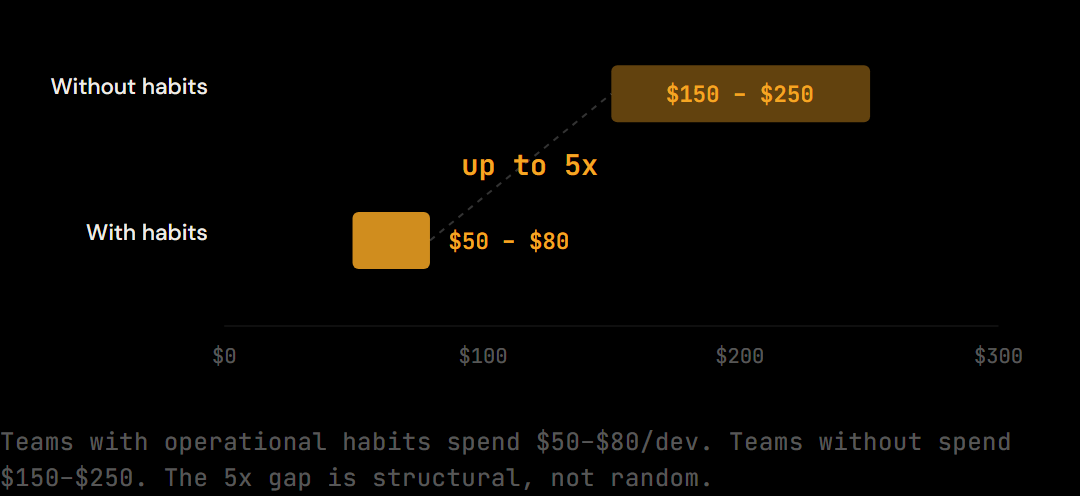
Teams with good habits spend $50-$80/dev/month. Teams without spend $150-$250. The 4 habits, plan comparisons, Opus 4.6 migration math, and ROI framework.
Teams with good operational habits spend $50–$80 per developer per month on Claude Code. Teams without them spend $150–$250. That gap is not random. It is not about which developers are more careful or which ones code faster. It comes down to four specific habits, one model migration opportunity, and whether your team has any visibility into where the tokens are actually going.
A 2025 analysis of 86,000 developers found that 40–60% of LLM API budgets go to operational inefficiencies, not the core work, but the overhead: repeated file reads, runaway thinking budgets, model mismatches, and context that grew past the point of usefulness. Multiply that across a ten person team for twelve months and you are looking at the difference between a $10,000 annual tool budget and a $30,000 one. LLM API spend doubled industry wide from $3.5 billion to $8.4 billion between late 2024 and mid-2025. The teams that are not controlling their spend are contributing disproportionately to that growth.
This guide covers the full operational picture: plan comparison, per developer cost distribution, the four habits that close the gap, the Opus 4.6 migration math, instrumentation setup, a team onboarding playbook, an ROI framework, and the subscription vs API decision. Every section is practical, with numbers you can put into a spreadsheet or a budget conversation.
TL;DR
- Team Standard ($20/seat) does not include Claude Code, you need Team Premium ($100/seat, 5-seat minimum).
- The biggest cost lever in 2026 is migrating off Opus 4/4.1 to Opus 4.6 (67% price reduction: $15/$75 → $5/$25 per million tokens).
- Four habits separate the $80/dev teams from the $250/dev ones: thinking token caps, model selection by task, context management discipline, and specific prompting.
- Infrastructure that gives you per-session cost visibility closes the remaining gap.
The real bill: what teams actually pay vs what they expect
Most teams underestimate their Claude Code spend at the planning stage. The actual distribution looks like this: a few developers run long agentic sessions that account for the majority of spend, while the rest of the team uses Claude Code lightly and predictably.
The mismatch between expected and actual spend has two causes. First, teams budget based on individual developer estimates of their own usage, which are systematically low because developers recall the quick interactions and forget the four hour debugging sessions. Second, teams do not account for the cost difference between habits. A developer running Claude Code without thinking token caps, on Opus by default, with no context management practice, will spend three to four times more per session than a developer who has internalized the habits in section 4.
The $50–$80 vs $150–$250 split is not a best case vs worst case range. It is typical with habits vs typical without habits. Both are realistic outcomes for a working software team. The difference is whether you have built the habits into your setup before the first invoice arrives.
Plan comparison: Team Premium vs API vs Max
Not all Claude plans include Claude Code. This is the first thing teams get wrong, and it affects the entire cost calculation.
| Plan | Monthly price | Claude Code included? | Usage billing | When this wins |
|---|---|---|---|---|
| Team Standard | $20/seat | No | N/A | Chat only workflows with no coding agent |
| Team Premium | $100/seat (5-seat min) | Yes | Included quota; overages at API rates | Teams that want a fixed floor with managed access |
| Enterprise | Negotiated seat fee | Yes | API rates on top of seat fee | Large orgs that need SSO, compliance, centralized billing |
| Max (individual) | $100–$200/month per user | Yes | Included quota | Individual power users who want predictable monthly spend |
| Direct API | No seat fee | N/A | Pure usage based | Teams that want per developer attribution and no seat overhead |
Source: Anthropic pricing page, accessed May 2026.
The Team Standard mistake costs teams real money. A company that signs up ten developers at $20/seat, $200/month, discovers none of them can use Claude Code. The feature is simply not included. To actually run Claude Code through the team plan, you need Team Premium at $100/seat minimum, with a five seat floor. That is a $500/month minimum before a single token is consumed.
The Enterprise plan is worth understanding separately: the seat fee covers Claude Code access, but usage is billed at API rates on top. The seat fee buys compliance features, SSO, and centralized billing controls, not included token quota. Teams evaluating Enterprise should model total cost as seat fee plus projected API usage, not seat fee alone.
The Max individual subscription at $100–$200/month includes a substantial quota but provides no per developer spend visibility in the native console. It is the right choice for individual developers who want cost predictability. For teams, the lack of attribution is a structural problem, you get one consolidated bill rather than per developer breakdowns.
The direct API path has no seat fee and bills purely on usage. For teams with variable usage patterns, some developers heavy, some light, API pricing plus per developer keys often comes out cheaper than the flat seat model. The tradeoff is operational complexity: you need to manage API keys, set spend limits, and build or buy the attribution layer.
The per developer cost distribution
Every team's Claude Code spend follows a power law distribution. The top 20% of developers by usage account for 60% or more of total token spend. This is not a problem to solve; it is a structural fact about how coding agents get used.
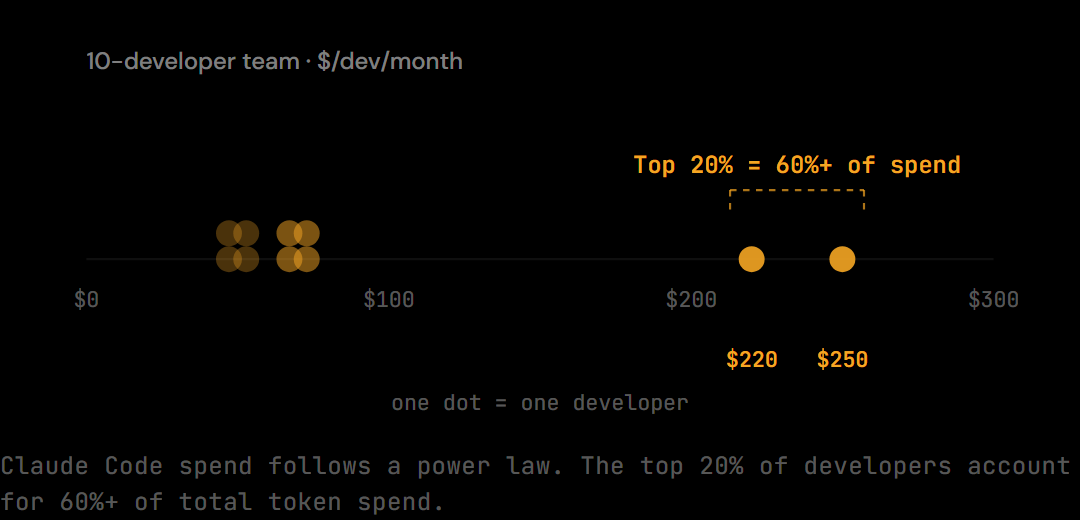
The developers burning the most tokens are usually running the longest agentic sessions: large refactors, multi file migrations, architecture level debugging, test suite generation across a whole codebase. These are also frequently the highest value sessions on the team. The question is not how to reduce their usage, it is whether you can see it before the invoice arrives.
Proxy log data from teams running through instrumented proxies shows a consistent pattern: three or four developers dominate spend in any given month, with the rest clustered near the $50–$80 baseline. When teams set a budget based on average spend, they are structurally blind to the high spenders until month end.
The practical implication: budget by distribution, not by average. If your median developer spends $60/month and your top 20% spend $200/month, a ten person team might have $600 in median spend and $400 in tail spend, $1,000 total versus the $600 the average spend model predicts. Plan for the tail. Set per developer spend alerts at 1.5x the team median so you see it coming rather than finding out after the fact.
Understanding the distribution also changes how you coach. The high spending developer is not doing something wrong, they are doing more. The coaching conversation is about habit adoption (thinking token caps, context management on long sessions), not about working less.
Source: Aggregate pattern from proxy session data; individual figures anonymized.
4 habits that separate $80/dev from $250/dev teams
The cost gap between efficient and inefficient teams is not mysterious. It is the aggregate of four daily habits applied consistently across every developer on the team. Teams that build these habits into their onboarding and shared tooling hit the $80/dev range. Teams that leave them to individual judgment land at $150–$250.
The habits are not restrictions, none of them require developers to do less work, use a worse model, or accept lower quality outputs. They are discipline patterns that reduce waste without reducing capability.
Habit 1: Thinking token caps
Claude Code's extended thinking mode burns tokens fast. A single deep think pass on a complex architectural question can consume more tokens than a full day of routine edits. The fix is a default cap, not a prohibition.
Running claude --max thinking tokens 4000 as a team default keeps the extended thinking feature available for hard problems while preventing it from running unconstrained on trivial ones. A developer asking Claude to rename a variable does not need 10,000 thinking tokens. A developer designing a distributed consensus mechanism might. Default to the cap; override explicitly when the task warrants it.
Set the cap in your shared CLAUDE.md and document it as the baseline. Let developers increase it explicitly when they need deep analysis. The policy should be written down: "Default thinking cap is 4,000 tokens. Override with --max thinking tokens when working on novel or complex architecture decisions." Default on, override when needed is the right posture. A cap that lives in a shared CLAUDE.md applies automatically to every developer on the team without requiring anyone to remember to set it.
Habit 2: Model selection by task
Not every task needs Opus. Sonnet handles most routine coding tasks, refactoring, test generation, documentation, small feature additions, code review comments, at roughly one third the cost per token. Reserving Opus for genuinely hard problems (complex architecture decisions, novel algorithm design, deep debugging across large codebases, multi step planning across many files) is the second biggest cost lever available after thinking token caps.
The challenge is that most teams leave model selection to individual developer judgment. Left to their own intuition, developers default to the best available model. This is rational from the developer's perspective, they want the best answer, but expensive from the team's perspective. Build explicit model selection guidelines into your CLAUDE.md and onboarding: Sonnet for anything that could be completed in under an hour, Opus for work that requires sustained multi step reasoning across a large codebase.
A useful framing: if you would not call a senior architect into the room for it, Sonnet probably handles it. If you would, reach for Opus.
For a deeper treatment of the input-volume problem, see the context engineering guide.
Habit 3: Context management
Context accumulation is the structural cost driver for long sessions. A developer who starts a Claude Code session to debug one module and ends three hours later with twelve files in context has been paying for every prior message, every tool result, and every file read on every subsequent turn. By turn 40, the cost per turn has multiplied several times over from what it was at turn 1. The session is expensive not because the work at turn 40 was expensive, but because of everything that accumulated before it.
Three practices close most of this gap. First, CLAUDE.md hygiene: keep the shared project CLAUDE.md under 600 tokens. A 5,000-token CLAUDE.md loads on every session start and every context refresh, at $3/M input tokens, that is $0.015 per session, which compounds to $30+ per developer per month for teams running 2,000 or more sessions monthly. Every token that does not belong in CLAUDE.md is a recurring cost. Second, /compact discipline: run /compact after extended sessions before continuing into a new phase of work, not after the session is already unrecoverably large. The right time to compact is when the session has covered a natural stopping point, not when the context is already bloated. Third, subagent isolation: spawn subagents for discrete tasks, file reads, searches, computations, isolated test runs, rather than running everything in the main context. Subagents explore in a separate context window, which keeps the primary conversation lean.
Related reading: the CLAUDE.md guide and context engineering.
Habit 4: Specific prompting
Vague prompts produce vague responses, and vague responses produce follow up turns. "Make this better" typically generates three or four additional clarifying turns before useful work begins. "Refactor this function to return a Result type instead of throwing, using the existing AppError class, and update the three callers in routes/auth.ts" generates one response and one review pass.
Precise prompts reduce the number of turns required per task. Fewer turns means less context accumulated per session. Fewer clarifying exchanges means less back and forth that shows up as token cost without producing output. The compounding effect across a team over a month is measurable.
Developers who write a one sentence task description before opening Claude Code consistently run shorter sessions, not because they are more efficient as engineers, but because the conversation starts with shared context and a clear target. The discipline of writing the prompt first is also a forcing function: if you cannot describe the task in one sentence, the task scope is unclear, which means Claude will have trouble with it too.
Teams can operationalize this by adding a one line prompt template to their shared CLAUDE.md: "Start each task with: [what you want] using [which files/patterns] to [what end state]." It sounds obvious. Teams that actually add it see measurable differences in average session length within a week.
Model selection: the Opus 4.6 migration opportunity
The single largest cost lever available to most teams in 2026 is migrating off Opus 4 and Opus 4.1 to Opus 4.6. Anthropic dropped the per token price by 67% between the two generations while preserving the model's capability profile.
| Model | Input price (per 1M tokens) | Output price (per 1M tokens) |
|---|---|---|
| Opus 4 | $15.00 | $75.00 |
| Opus 4.1 | $15.00 | $75.00 |
| Opus 4.6 | $5.00 | $25.00 |
Source: Anthropic pricing page, accessed May 2026.
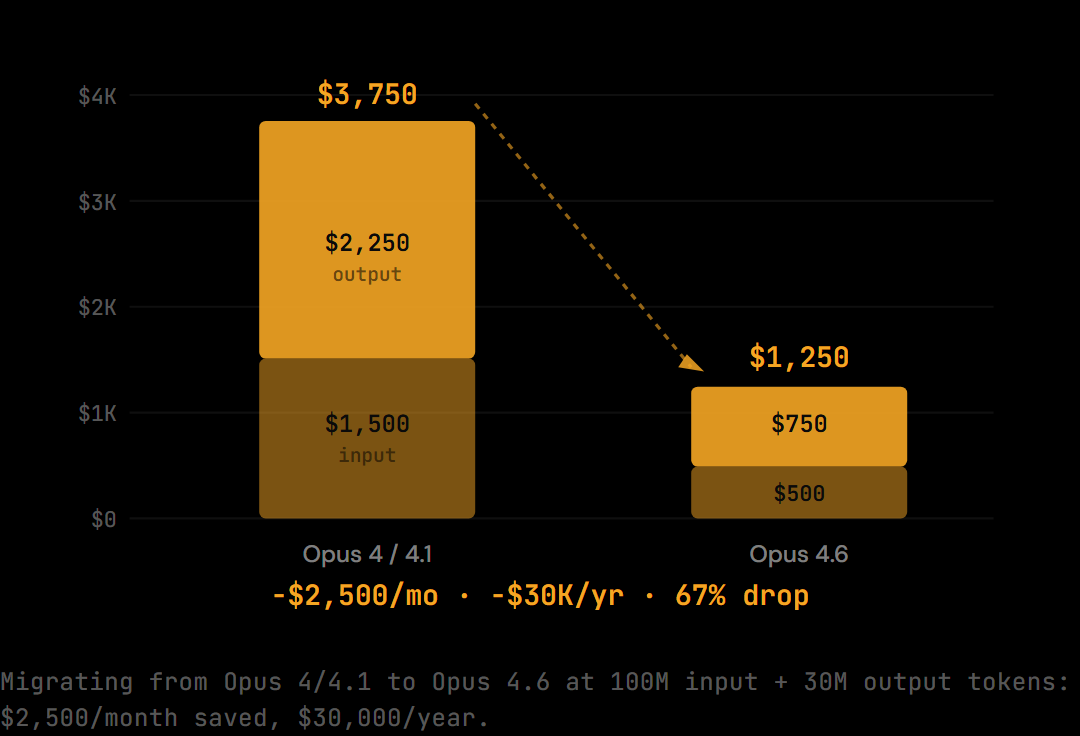
For a team running 100M input tokens and 30M output tokens per month on Opus, the migration math is direct:
Opus 4/4.1: ($15 × 100M) + ($75 × 30M) = $1,500 + $2,250 = $3,750/month
Opus 4.6:   ($5  × 100M) + ($25 × 30M) = $500  + $750  = $1,250/month
Monthly savings: $2,500
Annual savings:  $30,000
Based on pricing history analysis, this is the largest per token price reduction between consecutive Opus generations Anthropic has made. Teams running any meaningful Opus volume who have not yet migrated are leaving thousands of dollars per year on the table.
The migration is not automatic. Teams on Team Premium or Max subscriptions may still invoke Opus 4 explicitly in their CLAUDE.md or tooling configuration. Individual developers may have a default model set in their personal config that was not updated when Opus 4.6 launched. Audit your team's model usage logs, either via the Anthropic Console or a proxy, before assuming the migration has already happened. In practice, a significant fraction of teams running Opus 4 are doing so because their configuration was set once and never revisited, not because they actively chose Opus 4 over 4.6.
The migration checklist is short: check CLAUDE.md for explicit model references, check any shared tooling or CI configuration that invokes the API directly, and verify that each developer's personal configuration is not pinned to an older model. One hour of work for a ten person team. The payoff at meaningful Opus volumes is immediate.
Instrumentation: how to see where your money is going
You cannot manage what you cannot measure. The gap between teams that spend $80/dev and teams that spend $250/dev is not just habits, it is visibility. Efficient teams know which sessions are expensive before the invoice arrives. Inefficient teams find out at month end, when there is nothing to be done about it.
There are three instrumentation layers, and most teams only have access to the first one natively.
Layer 1: Anthropic Console usage dashboard. The console shows per API key usage with daily granularity. If every developer has a separate API key, you can see per developer spend in the console with no additional tooling. This is the minimum viable instrumentation setup. If your team is using a shared API key, the console shows total spend only, you cannot see which developer drove which cost.
Layer 2: Per developer attribution. Getting per developer data on a shared key requires either a strict key per developer policy (which solves the problem natively via the console) or a proxy layer that adds developer attribution headers to each request before forwarding it to Anthropic. A proxy can inject an identifier from the request context, machine hostname, developer name, team tag, that allows you to slice spend by developer even on a shared API key. Without one of these two approaches, shared key teams are flying blind on attribution.
Layer 3: Per session breakdown. Neither the console nor per developer keys tell you which session or specific task drove the cost. For per session visibility, knowing that a particular debugging session cost $12 while the rest of the day cost $3, or that a specific subagent run cost more than a whole week of routine edits, you need session level instrumentation. This requires either a custom logging layer in your tooling or a proxy that tracks session boundaries and reports per session totals.
The data gap is the cost gap. Teams that lack per session visibility have no mechanism to identify which session patterns are expensive, no way to coach developers who are consistently running costly sessions, and no early warning when a session is about to produce a surprising line item. The absence of instrumentation is not neutral, it makes the $250/dev outcome structurally more likely because there is no feedback loop.
Team onboarding playbook for cost conscious Claude Code use
The habits and instrumentation above are only effective if they are built into onboarding from the start, rather than left to each developer to discover independently. The playbook approach encodes the knowledge once and applies it to everyone from day one.
Seven steps take a team from default Claude Code setup to cost conscious operation:
-
Issue per developer API keys. Shared keys obscure attribution. Every developer gets their own key, tied to their identity in the Anthropic Console.
-
Set thinking token defaults in shared CLAUDE.md. Add
--max thinking tokens 4000as the documented team default. Document when to override it, for deep architecture work, novel algorithmic problems, or production incidents. Putting this in the repo's CLAUDE.md means it applies to every developer automatically. -
Document model selection guidelines. Sonnet for routine work (refactoring, tests, documentation, small features), Opus 4.6 for hard problems (novel architecture, complex debugging, multi step planning). Include example tasks in each category. Make it part of onboarding documentation, not a wiki footnote.
-
Train on
/compactand subagent patterns. Run a thirty minute onboarding session where developers practice running/compactat the end of a session phase, and practice launching subagents for discrete read tasks rather than pulling context into the main conversation. -
Set up weekly per dev cost reports. Send a weekly digest showing each developer's spend versus team median. Visibility alone shifts behavior within two to three weeks.
-
Define an escalation policy. When a developer's usage hits 1.5x the team median in a given week, the manager checks in, not to penalize, but to understand. The check in is awareness and habit coaching, not cost policing.
-
Run a quarterly cost review. Identify the top sessions by cost across the team and ask whether they produced proportionate value. This keeps the cost conversation alive without making it a daily friction point.
ROI calculation framework
Claude Code has a cost. It also has a value. Most teams track the cost carefully and estimate the value loosely. A simple framework closes the gap and gives the engineering manager something concrete to take into budget conversations.
The formula:
Monthly value = (hours saved/dev/week) × (dev hourly rate) × 4.3 weeks × number of devs
Monthly cost  = cost per dev per month × number of devs
ROI           = monthly value / monthly cost
Worked example, ten person team, conservative inputs:
Anthropic's published productivity research shows a 10–30% time savings range for developers using AI coding assistants regularly. The variance depends heavily on task type: writing new code and generating tests show higher gains than debugging unfamiliar systems or reviewing others' code. Using the conservative end (10% time savings, roughly 4 hours per week for a developer working 40 hours):
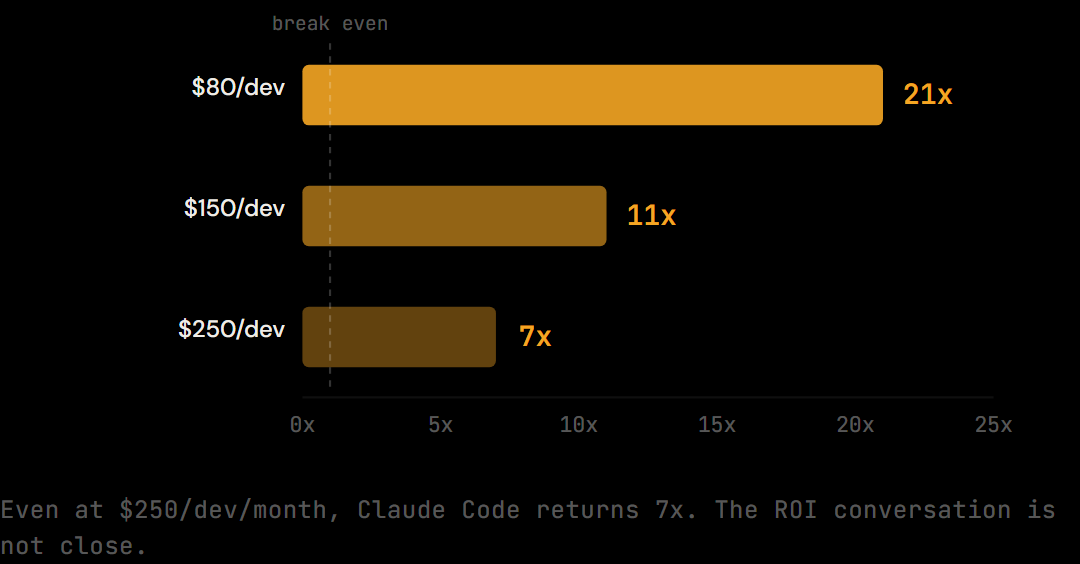
Monthly value = 4 hr/week × $100/hr × 4.3 × 10 devs = $17,200/month
Monthly cost  = $80/dev × 10 devs = $800/month
ROI           = 21x
Even at the pessimistic end of the productivity estimate and the high end of the cost range ($150/dev), the ROI remains strongly positive:
Monthly value = 4 hr/week × $100/hr × 4.3 × 10 devs = $17,200/month
Monthly cost  = $150/dev × 10 devs = $1,500/month
ROI           = 11x
Source: Anthropic productivity research, 2025. Hourly rate is illustrative; substitute your team's actual blended engineering rate for accurate figures.
The ROI calculation is most useful as an ongoing operational benchmark, not a one time justification. Run it quarterly alongside the cost review. If cost per developer rises while time savings stay flat, the habits in section 4 have slipped. If cost drops after implementing thinking token caps but time savings also drop, the cap settings may be too aggressive.
To answer the "when does it stop paying for itself" question: calculate the break even cost per developer at your team's hourly rate and time savings estimate, then set a cost alert at that threshold.
For the caching side of the equation, see the prompt caching guide.
When API pricing beats subscriptions (and vice versa)
The subscription vs direct API decision is not obvious, and the right answer changes as your team grows and your usage patterns become clearer. The key variable is usage variance.
Subscription (Team Premium or Max) wins when:
- Usage is predictable month to month with low developer to developer variance
- Every developer consistently uses Claude Code enough to hit the included quota floor
- You want billing simplicity, one line item, fixed amount, easy to budget
- Per developer attribution is not a priority (or you have solved it via per developer API keys)
Direct API wins when:
- Usage is bursty or project dependent, heavy during a major feature push, light during maintenance phases
- There is high developer to developer variance (some developers use Claude Code heavily every day, others only occasionally)
- Per developer attribution matters and you want it visible natively in the Console
- You are willing to invest in instrumentation and key management
Hybrid wins for most teams above ten developers:
- A subscription floor for all developers ensures consistent access and a predictable baseline cost
- Direct API keys for the top usage developers give you attribution and avoid subscription overage penalties
- One developer tracked 10 billion tokens over 8 months at $100/month on Claude Code Max, the same volume at direct API rates would have cost approximately $15,000. The Max subscription provided 99% cost savings for that specific usage pattern
The hybrid approach requires managing two billing relationships, but for teams with meaningful usage variance, the math typically justifies the overhead.
A practical entry path: start all developers on Max subscriptions for the first 90 days to establish baseline usage data. After 90 days, review the distribution. Developers who consistently exceed the Max quota are candidates for direct API with spend limits. Light users stay on subscription. Revisit quarterly as team size and project cadences change.
The Distillery as team cost management infrastructure
Good habits close most of the $80–$250 gap. Infrastructure closes the rest, and it makes the habits easier to maintain.
The Distillery is a token aware proxy that sits on the wire between Claude Code and Anthropic. It adds per developer attribution to every request without requiring per developer API keys, tracks session level cost in real time so you see expensive sessions as they happen rather than at month end, and applies context compression to reduce payload sizes before they reach the API. For teams without the engineering bandwidth to build a custom logging layer or attribution proxy, it provides layers 2 and 3 of the instrumentation stack out of the box. Pair the operational habits in this guide with a proxy that catches the sessions that slip through individual discipline, the runaway debugging session that ran until midnight, the subagent that read the same configuration files seventeen times, the thinking budget that was left at the default on an automated pipeline job, and you close the gap without relying entirely on developer memory.
Frequently Asked Questions
Does Team Standard ($20/seat) include Claude Code?
No. Team Standard includes Claude.ai chat access but does not include Claude Code. To use Claude Code under a team plan, you need Team Premium at $100/seat with a five seat minimum, which means the minimum team cost is $500/month before a single token is consumed. This is a common source of billing confusion for engineering teams that see "$20/seat" in the pricing page, sign up ten developers, and then discover that the coding agent they evaluated is only available on the Premium tier.
What is the average per developer cost on Claude Code?
It varies significantly by usage pattern and habit adoption. Teams with good operational habits, thinking token caps, deliberate model selection, context management, specific prompting, typically spend $50–$80 per developer per month. Teams without these habits typically spend $150–$250. The gap is operational, not inherent to the tool. The same developer, doing the same work, will spend materially less after three weeks of habit adoption than they did in their first three weeks on the platform.
Should we use Max subscriptions or direct API for our team?
It depends on usage variance. Max subscriptions work well for teams with predictable, consistent usage where every developer regularly uses Claude Code enough to justify the $100–$200/month floor. Direct API works better for teams with high developer to developer variance, because you only pay for what is actually consumed. Most teams above ten developers benefit from a hybrid: subscriptions for predictable users, direct API keys for heavy users. Use the first 90 days of adoption to collect per developer data before committing to one billing model.
How do we attribute Claude Code costs to specific developers?
The most straightforward approach is issuing separate API keys per developer. The Anthropic Console tracks usage per API key with daily granularity, so per developer spend becomes visible natively without any additional tooling. If your team is on a shared API key, you need either a key per developer policy or a proxy layer that adds per developer attribution metadata to each request before forwarding it. Without one of these two approaches, you will see total team spend but not the distribution that drives it.
When does Claude Code stop paying for itself?
The ROI turns negative when the cost per developer per month exceeds the value of the time saved by that developer. Using Anthropic's conservative 10% productivity estimate at a $100/hr blended engineering rate, the break even is approximately $430/developer/month, roughly 5x the typical $80/dev cost under good habits, and 1.7x the high spend $250/dev level. In practice, teams that find Claude Code not paying for itself are typically seeing one of three problems: developers are not using it consistently enough for the productivity gains to compound across their workflow, costs have grown past the $80–$150/dev range because operational habits were not established at onboarding, or the tasks being delegated to Claude Code are poor fits for the tool, highly ambiguous requirements, heavily context dependent decisions, or work that requires institutional knowledge that cannot be captured in a prompt.
Try it on your own Claude Code sessions.
The Distillery applies these distillations automatically. Free token optimization, forever.