AI Coding Assistant Total Cost of Ownership: The Real Numbers for 2026
Sticker prices lie. Claude Code, Cursor, Copilot, Windsurf, real TCO with seat fees, usage costs, overages, and productivity adjusted ROI for teams of 1, 10, and 50.
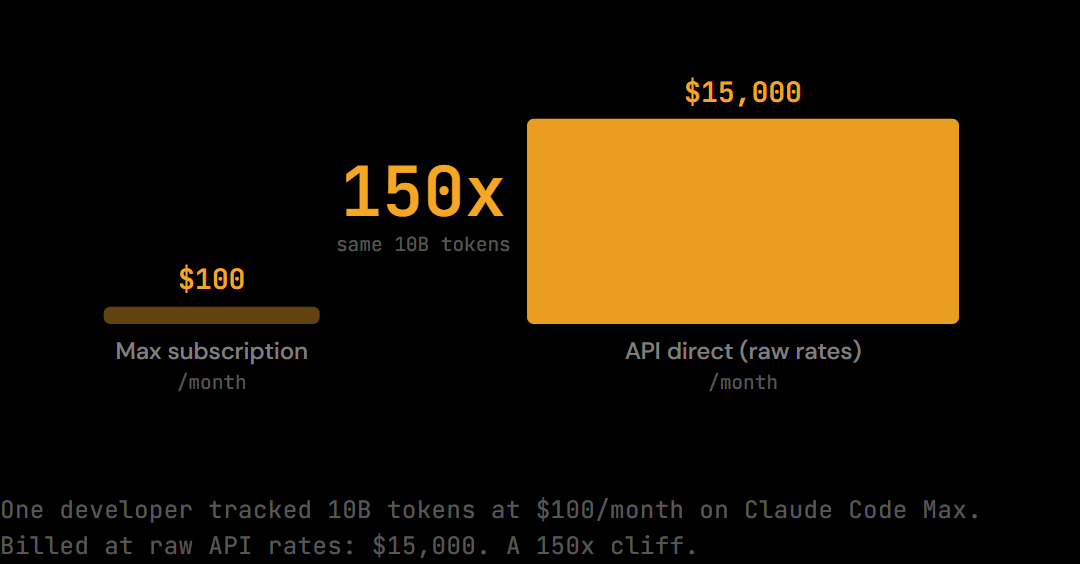
One developer tracked 10 billion tokens over 8 months on Claude Code Max at $100 per month. The same usage volume billed at standard per token API rates would have come to roughly $15,000. That is a 150x cost compression, hidden entirely behind the headline "Claude Code costs $100 a month."
Sticker price comparisons miss this entirely. They look at what you pay on the first invoice. TCO asks what you pay when usage scales, when developers push past tier limits, when you add seats, when the subscription you chose for 3 developers needs to serve 30.
This guide does the math that pricing pages do not. You will come away with a framework to calculate your actual cost across Claude Code, Cursor, GitHub Copilot, and Windsurf, at solo, small team, and enterprise scale.
TL;DR
- The gap between a $20/month subscription and real API costs at heavy usage is 10x to 150x.
- Subscription tiers protect you at light usage; they become a ceiling problem at heavy usage.
- The crossover point is around $150/dev/month, where API direct with cost controls often beats the next subscription tier up.
Why Sticker Price Comparisons Are Misleading
Every comparison article lines up the four or five major AI coding tools and compares their listed prices. Claude Code: $20 or $100. Cursor: $20, $40, $60, or $200. Copilot: $10, $19, or $39. Windsurf: $15, $60, or $200. The conclusion is usually a table sorted by cheapest monthly sticker.
The problem is that sticker price is the floor, not the ceiling. Three things push the real number higher.
First, usage cliffs. Most subscription tiers have usage limits. When you hit them, some tools throttle output; others charge overages. The overage rate is almost never disclosed prominently.
Second, hidden seat economics. Enterprise tiers require minimums. Claude Code Team Premium has a 5-seat minimum. That is $500/month before anyone opens a terminal.
Third, the API switch. When subscription tiers no longer cover your usage, the logical next step is API direct. API direct pricing is usage billed at full per token rates. That is the cliff. The same token volume that cost $100 under a Max subscription costs $15,000 at API rates without optimization infrastructure in place.
TCO covers all three: seat fees, usage costs at realistic workloads, and what happens when you exceed tier limits.
The Tools and Their Pricing Tiers (Side by Side)
Current pricing as of May 2026. All prices per developer per month unless noted.
| Tool | Entry Tier | Mid Tier | Top Tier | Usage Model |
|---|---|---|---|---|
| Claude Code (Anthropic) | Pro $20/mo (bundled) | Max $100/mo | API direct (usage billed) | Subscription or per token API |
| Cursor | Pro $20/mo | Business $40/mo | Pro+ $60/mo / Ultra $200/mo | Flat subscription; overages on Pro+ |
| GitHub Copilot | Individual $10/mo | Business $19/mo | Enterprise $39/mo | Flat subscription; usage capped |
| Windsurf | Entry $15/mo | Pro $60/mo | Max $200/mo | Flat subscription; throttling at limits |
| Cline / API direct | $0 seat fee | $0 seat fee | $0 seat fee | Usage billed at provider rates |
A few notes on what these tiers actually deliver.
Claude Code Pro is bundled with a Claude.ai Pro subscription. Claude Code Max at $100/month grants heavier usage within Anthropic's managed infrastructure, not unlimited API access. Claude Code Max 5x is a $500/month tier for extremely high volume use. Once a developer exceeds Max tier limits, the next option is API direct at full per token rates, that is the cliff.
Cursor Pro+ at $60/month includes usage, but usage beyond the included amount triggers overage billing. The Pro+ overage rate is not prominently displayed. Cursor Ultra at $200/month is positioned as the "unlimited" tier for power users, but reports of throttling at sustained heavy usage exist.
GitHub Copilot is the simplest model: fixed seats, no meaningful overages. The tradeoff is a ceiling on what the tool can do, it is optimized for inline completion, not long horizon agentic work.
Windsurf mirrors Cursor's structure: flat subscription with throttling at limits rather than hard overage billing.
Cline and similar API direct tools have zero seat fee. You pay only for tokens consumed, billed at whatever provider rate applies. This is the cheapest option per developer at low usage, and the most expensive per developer at heavy usage without optimization infrastructure.
Real Usage Cost at Three Levels: Light, Moderate, Heavy
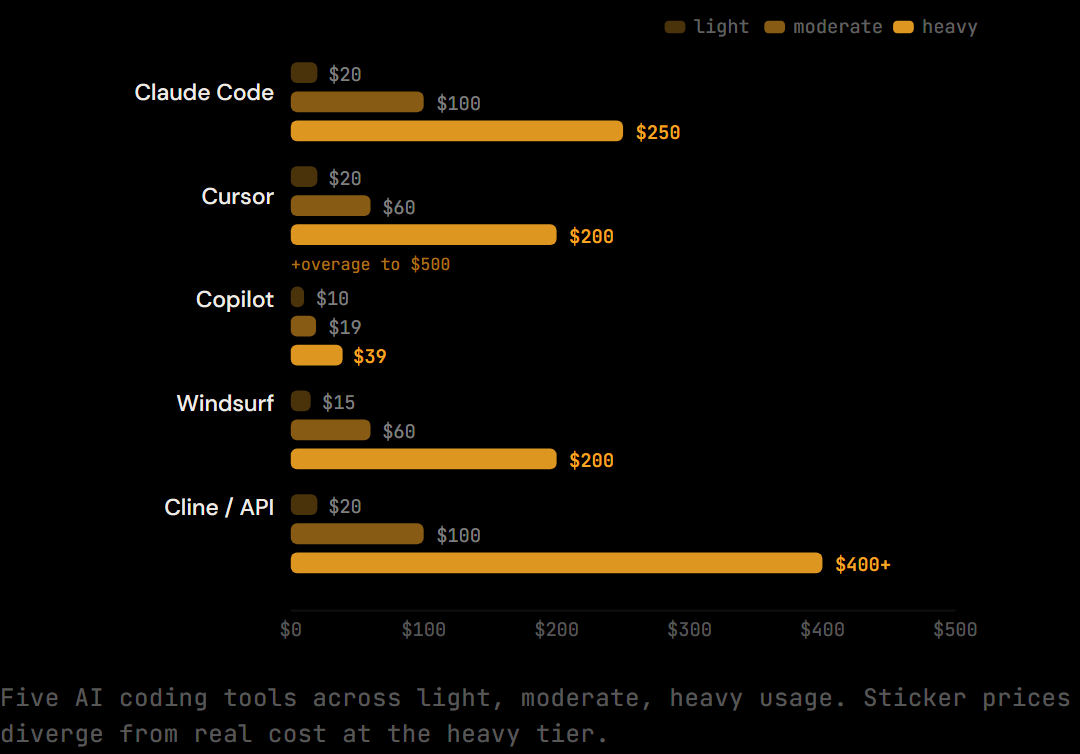
Pricing tiers describe what you pay at the floor. Real cost depends on how much you actually use the tool.
Light usage (5-10 hours per week): A developer running one or two focused sessions per day, each wrapping up in 20-30 turns, burns roughly 1-3 million tokens per month. At this level, every subscription tier in the table above covers the usage comfortably. Real cost for all tools: $20-$40/dev/month. Subscription tiers win; API direct would cost roughly the same or slightly more when accounting for the per token rates.
Moderate usage (15-25 hours per week): Two to four sessions per day, some of them deep (40+ turns, file reads included in context). Token burn is 5-15 million per month. Cursor Pro+ at $60/month absorbs most of this; Claude Code Max at $100/month covers it. Copilot starts to feel limiting because the tool does not support the depth of agentic work these users run. Real cost: $50-$100/dev/month for subscription tools. API direct at this level would run $60-$150/month at Sonnet rates, which is comparable, but without the subscription's ceiling protection if usage spikes.
Heavy usage (30+ hours per week): This is the category where sticker prices become fiction. Heavy users running 4-6 deep sessions per day accumulate 20-60 million tokens per month. Claude Code Max ($100) hits limits and throttles. Cursor Ultra ($200) gets triggered. Windsurf Max ($200) gets triggered. Real observed cost in developer communities: $100-$250/dev/month across all tools.
One developer reported a $1,400 month on Cursor because overage rates kicked in after exceeding the Pro+ included usage. Cursor's overage rates on Pro+ can push monthly bills to $200-$500 before a developer notices something is wrong. This is not an edge case, it affects developers who use Cursor as their primary coding tool for intensive work.
The implication: for heavy users, the "cheapest" listed tier is rarely the tier they end up on. Budget for the next tier up, and for possible overages, not the entry price.
Hidden Costs: Overages, Overage Risk, API Cost Cliffs
Three cost categories are systematically underweighted in sticker price comparisons.
Overages. Cursor Pro+ at $60/month includes a usage allotment. Exceed it and you are billed at overage rates. The overage rate varies and is not prominently communicated at signup. Developers who run heavy workloads on Cursor Pro+ without monitoring this have reported $200-$500 months. Windsurf has soft limits with throttling rather than hard overage billing, usage slows, quality degrades, but the bill stays predictable. Claude Code Max throttles at limits rather than charging overages. Understanding which model each tool uses before committing to a tier matters.
Switching cost. Moving from a subscription to API direct is not free. API direct mode requires per developer API keys, Anthropic billing setup, and ideally instrumentation to track per developer spend. Without instrumentation, API direct is a black box: you get a total API bill at the end of the month with no visibility into which developer or project drove it. The setup and operational cost of proper instrumentation is real work.
The API cliff. This is the most consequential hidden cost, and the one most developers encounter without warning. When usage exceeds subscription quotas, the natural next step is API direct. Standard API rates are $3/million input tokens and $15/million output tokens for Sonnet. Without prompt caching, context compression, or other optimization, a developer's subscription level usage can cost 10-150x more at API rates than it did under the subscription. The 150x figure above (10 billion tokens, $100/month vs $15,000 equivalent) is real and not exceptional for heavy Claude Code users. Scaling a team from a subscription to API direct without cost controls in place can multiply the team's monthly spend dramatically, overnight.
The Subscription vs API Tradeoff (and When Each Wins)
The choice between subscription and API direct depends on usage patterns, not just volume.
Subscriptions win when: Usage is predictable and consistent. Every developer on the team uses the tool similarly, no high variance outliers who run 10x the median. Budget requires predictability. Billing simplicity matters (one seat fee per developer, no usage tracking required). The team is small and per developer attribution is not a priority.
API direct wins when: Usage is bursty and uneven across developers. Some developers run heavy workloads; others are light users. Per developer cost attribution matters for chargebacks, budget tracking, or accountability. The team has scaled past the highest subscription tier and usage based billing with good controls is cheaper than the tier above.
The crossover point: For most teams, the financial crossover happens around $150/dev/month of actual usage. Below that, subscription tiers provide value through rate compression. Above it, API direct with cost optimization infrastructure (prompt caching, context compression, model selection) often comes out ahead even at full API rates, because the optimization layer can reduce effective cost by 30-60%.
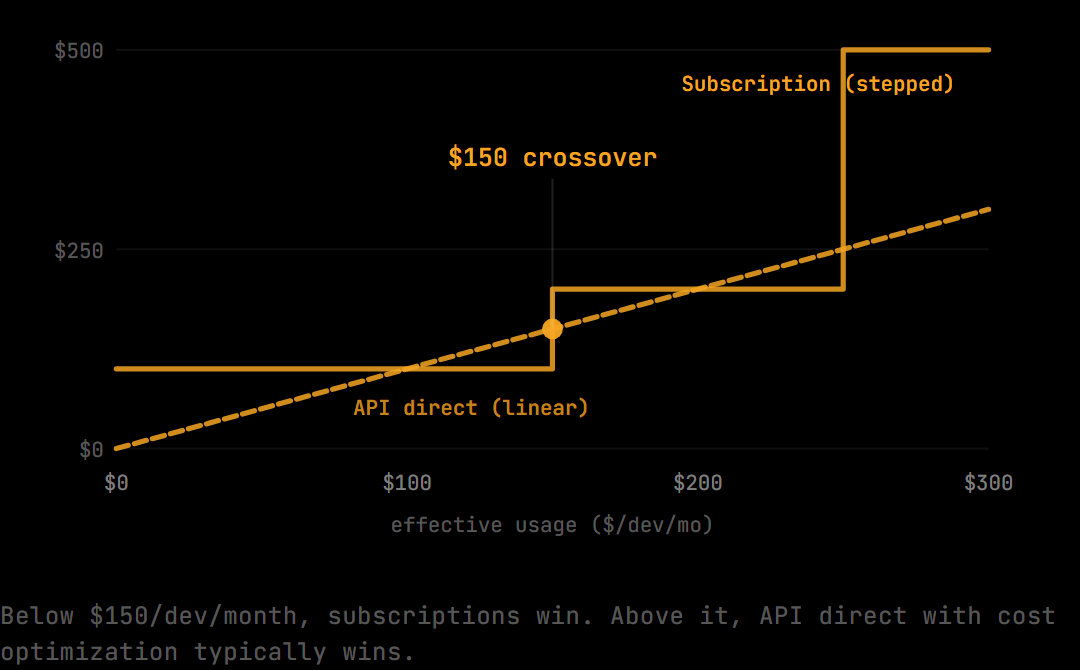
The decision is not just financial. Subscriptions require no per developer setup. API direct requires operational investment. Factor in engineering time spent on instrumentation, and the API direct break even shifts higher.
Team Scale Economics: 1 vs 10 vs 50 Developers
Solo developer, small team, and mid size team operate in fundamentally different cost regimes.
1 developer: The math is straightforward. Subscription almost always wins at light and moderate usage. $20-$100/month depending on tool and workload. Solo developers have full visibility into their own usage, so overages are discoverable quickly. API direct is reasonable for a solo heavy user who wants per session attribution. Realistic range: $20-$200/month.
10 developers: The team minimum problem emerges. Claude Code Team Premium requires a 5-seat minimum at $100/seat, that is $500/month before anyone starts working. Cursor Business at $40/seat is $400/month for 10 developers regardless of usage. Per developer attribution becomes valuable because high spending developers can distort the average. A team where 2 of 10 developers are heavy users will see a team average that hides 3x variance at the individual level. Instrumentation starts to matter. Realistic range: $500-$2,500/month for a 10-person team across all tools.
50 developers: At 50 seats, API direct becomes financially attractive relative to subscription tiers. The math: 50 seats of Claude Code Team Premium is $5,000/month in seat fees alone. Cursor Business at 50 seats is $2,000/month. But at 50 developers, usage patterns vary significantly. If half the team is light users, you are paying full subscription rates for developers who would cost $20-$30/month on API direct. API direct with proper instrumentation, per developer key management, cost alerts, usage dashboards, can reduce spend significantly compared to uniform subscription tiers. The tradeoff: a real FinOps function is required to operate it well. Realistic range: $5,000-$25,000/month at 50 developers, depending on tool selection and usage habits.
[INTERNAL-LINK: full breakdown of team costs, per developer benchmarks, and onboarding checklists → /blog/true-cost-of-claude-code-for-teams/]
The per developer cost at scale also surfaces a composition problem: not all developers use AI coding tools equally. A cost model that assumes uniform usage across 50 developers will be wrong. The range reported across developer communities is 3-10x between light and heavy users on the same tool.
Productivity Adjusted Cost (ROI per Dollar)
Raw TCO is the wrong final metric. The right metric is cost divided by productivity gain.
Anthropic's published research cites 10-30% productivity improvement for developers using Claude Code in agentic workflows. Independent developer surveys have reported similar ranges. Take the conservative end: 10% productivity gain for a developer billing at $100/hour, working 40 hours per week.
10% of 40 hours per week = 4 hours saved per week. 4 hours × $100/hour = $400/week in recovered developer time. $400/week × 4.3 weeks/month = $1,720/month in recovered value.
At that figure, even a $250/month AI coding tool delivers a 6.9x ROI monthly. Even a $500/month bill in a bad month with overages returns positive ROI if the developer is delivering value.
The productivity math matters for budget conversations. Engineering managers arguing for AI coding tool budgets have a clear frame: the tool cost is not $100-$200/month, it is $100-$200/month against $1,000-$2,000/month in recovered productivity. The budget case is not close.
The caveat: these gains are not automatic. Developers who use the tool poorly, running redundant searches, accumulating bloated context, not structuring prompts effectively, see smaller gains. The 30% end of the range is achievable; hitting it requires deliberate workflow investment.
[INTERNAL-LINK: CLAUDE.md setup guide for productive Claude Code sessions → /blog/the-complete-claude-md-guide/]
The Hybrid Stack Approach
Most developers in practice are not on a single tool. They run two or three, each optimized for a different job.
A common pattern among power users:
- Cursor Pro ($20), inline IDE completion, single file refactors within the editor
- Claude Pro ($20), chat and long context work, research, planning sessions
- GitHub Copilot Pro ($10), lightweight completion fallback, cheap backup layer
Total: $50/dev/month as a baseline, covering most coding assistance needs.
This stack avoids the ceiling problem of relying on a single tool for everything. Cursor handles the inline workflow without burning API tokens on agentic tasks. Claude Pro handles chat without Cursor's per session context reset. Copilot stays on as a cheap always available fallback.
The implication for TCO analysis: you can not compare tools in isolation. A developer who uses Cursor Pro for inline work and Claude Code API for agentic sessions is not paying $20/month (Cursor) or $200/month (Claude Code API direct). They are paying both, plus the hybrid provides optionality that neither alone delivers.
When calculating team TCO, ask which tools each developer is actually running, not which one was "chosen" for the team. Shadow IT in AI tooling is common. Developers purchase personal subscriptions when the team approved tool does not fit their workflow.
Decision Framework: Which Tool(s) for Your Situation
No single answer fits all usage patterns. Use this framework:
Solo developer, predictable workload
Light to moderate usage, consistent daily patterns, no agentic deep work. Claude Pro ($20) or Cursor Pro ($20) depending on whether you prefer chat first or IDE first workflows. Both cover costs without surprises.
Solo developer, heavy or variable workload
Heavy agentic use, long sessions, deep codebase work. Claude Code Max ($100) is the cost controlled option, gives access to Claude's full agentic capabilities without exposure to raw API rates. Alternatively, the hybrid stack ($50) works if you can structure your usage to stay within each tool's subscription value zone.
[INTERNAL-LINK: prompt caching strategies that cut API costs by up to 90% on repeated context → /blog/prompt-caching-claude-complete-guide/]
Small team (5-10 developers), centralized workflow
Claude Code Team Premium or Cursor Business. Seat fees apply regardless of usage. Make sure every developer uses the tool enough to justify the seat cost. At 10 seats, a developer who barely touches the tool is $40-$100/month of waste.
Mid size team (10-50 developers), mixed usage
API direct with per developer attribution becomes worth considering. Requires: per developer API key management, usage dashboards, cost alerts per developer, and ideally a FinOps function to own the monitoring. At 20+ developers with high usage variance, the blend of subscription rates for light users and API direct for heavy users is typically the financially optimal structure.
Large team (50+ developers)
API direct plus infrastructure. Subscription tiers at 50+ seats cost $2,000-$5,000/month in seat fees before usage. API direct with prompt caching, context compression, and model selection control offers genuine savings at this scale, but only with real instrumentation. Budget for the engineering work required to instrument it properly.
[INTERNAL-LINK: full TCO guide for teams with 10+ developers and FinOps considerations → /blog/true-cost-of-claude-code-for-teams/]
When the Calculator Says API but You Still Want Subscriptions
Sometimes the TCO math clearly favors API direct, but the team stays on subscriptions anyway. This is not irrational.
Subscriptions have genuine soft benefits: predictable billing for finance to approve, no per developer setup burden, no overage surprises, simpler procurement process. Engineering managers who do not want to own a FinOps function often prefer the simplicity of seat based pricing even when it costs more on paper.
The answer many teams land on is a middle path: a proxy layer that sits between their tools and the API, providing subscription style economics (predictable, capped spend) with API style attribution (per developer visibility). This approach separates the tooling decision from the billing decision: teams use whatever AI coding tools fit their workflow, and the cost layer handles optimization, attribution, and spend control underneath.
The Distillery's Role in Claude Code TCO
When Claude Code workflows scale past a subscription tier, the logical next step is API direct. API rates are $3/million input tokens and $15/million output for Sonnet, rates that expose full usage without a subscription buffer.
The Distillery sits on the wire between Claude Code and the Anthropic API. Before each request is forwarded, it compresses shell output, removes redundant file reads, and eliminates stale tool results from the context window. The result is a smaller payload forwarded to Anthropic, 30-60% smaller depending on session patterns. At $3/million input tokens, sending 40% fewer tokens means spending 40% less.
For teams moving from subscriptions to API direct, The Distillery closes the gap between subscription level economics and API level transparency. You get per developer cost attribution and the flexibility of usage based billing, without the uncontrolled spend exposure that raw API direct creates.
Frequently Asked Questions
Which is cheapest in 2026: Claude Code, Cursor, or Copilot?
It depends on usage level. At light usage (1-2 short sessions per day), GitHub Copilot at $10/month is the cheapest option. At moderate usage, Cursor Pro at $20/month and Claude Code Pro at $20/month are comparable. At heavy usage, the tools diverge significantly: Copilot does not support the depth of agentic work heavy users need; Cursor can hit overages on Pro+; Claude Code Max at $100/month provides the most cost controlled heavy use environment. There is no single cheapest tool because the cheapest option depends on what you are actually doing with it.
When does direct API beat a subscription for AI coding tools?
When your usage exceeds what a subscription tier covers, and you have cost control infrastructure in place (prompt caching, context compression, per developer monitoring). Without infrastructure, API direct at heavy usage almost always costs more than a subscription. The crossover with infrastructure is around $150/dev/month of effective usage. Above that, well instrumented API direct is typically cheaper.
Is Cursor Ultra worth $200/month?
For developers whose primary workflow is Claude powered coding inside the Cursor IDE, running 4-6 sessions per day with deep agentic work, Cursor Ultra is roughly equivalent in cost to what they would pay in Cursor Pro+ overages. In that specific case, $200/month for Cursor Ultra removes the overage risk and provides budget predictability. For moderate users at $40-$60/month of actual usage, Cursor Ultra is expensive by a wide margin. The break even is developers who are already hitting $150-$200/month in Cursor Pro+ costs before the upgrade.
How much does a typical developer spend on AI coding tools in 2026?
The range is wide. Light users: $20-$40/month. Moderate users (the median): $50-$100/month. Heavy users: $100-$250/month. Power users with hybrid stacks or heavy API usage: $200-$500/month. The $100/month mark is the rough median for developers who use AI coding tools as a primary part of their workflow. Teams that have implemented cost optimization typically see $50-$80/dev/month; teams without it often see $150-$250/dev/month.
Can I claim AI coding tools as a business expense?
Yes in most jurisdictions, if they are used for business purposes. In the US, AI coding tool subscriptions used for work are a legitimate business expense under the same treatment as software subscriptions. Self employed developers can deduct them directly. Employed developers may be able to claim unreimbursed business expenses depending on their situation, but the more common path is to expense them through the company. API costs billed to a business account are cleaner to claim than personal subscriptions. Consult a tax professional for your specific situation; this is a software cost that most businesses can write off.
Try it on your own Claude Code sessions.
The Distillery applies these distillations automatically. Free token optimization, forever.