Copilot vs Claude Code (2026): $120 vs $4,800/yr TCO
Copilot: $120-228/year flat. Claude Code: $540-4,800/year metered. 12-month TCO compared at light, moderate, and heavy use, verdict by user type.
GitHub Copilot is $10-19/month. For light usage, it probably costs less than Claude Code.
That sentence is worth stating directly, because a lot of comparisons between these tools avoid saying it. The question is not which tool has a lower entry price, Copilot clearly does. The question is whether they are the same tool, what each costs over 12 months at different usage levels, and when the cost difference becomes worth paying.
TL;DR
- GitHub Copilot is $120/year (Individual) or $228/year per seat (Business). Both are flat subscriptions with no usage meter.
- Claude Code is metered through the Anthropic API at $3/M input and $15/M output. Light users hit ~$540/year, heavy users hit $4,800/year or more.
- Copilot is IDE integrated completion plus chat. Claude Code is an agentic terminal tool that operates across the codebase autonomously.
- The cost comparison is real but compares different categories of tool. Copilot does not provide agentic multi file workflows; Claude Code does not provide inline IDE completion.
- For committed Claude Code users, 30-60% reduction (depending on session patterns) at the proxy layer cuts a $4,800/year bill significantly, a 40% standard benchmark reduction cuts it to ~$2,880/year, a $1,920 swing that closes some of the gap.
What GitHub Copilot Costs
GitHub Copilot Individual is $10/month, $120/year. GitHub Copilot Business is $19/month per seat, $228/year per seat. Both are flat subscriptions with no token billing or usage meter. The full 12-month cost is fixed at signup; there is no possibility of an unexpected invoice spike.
At 12 months:
- Individual: $120/year
- Business: $228/seat/year
That is the full cost. No API invoice. No per session math.
What Claude Code Costs Over 12 Months
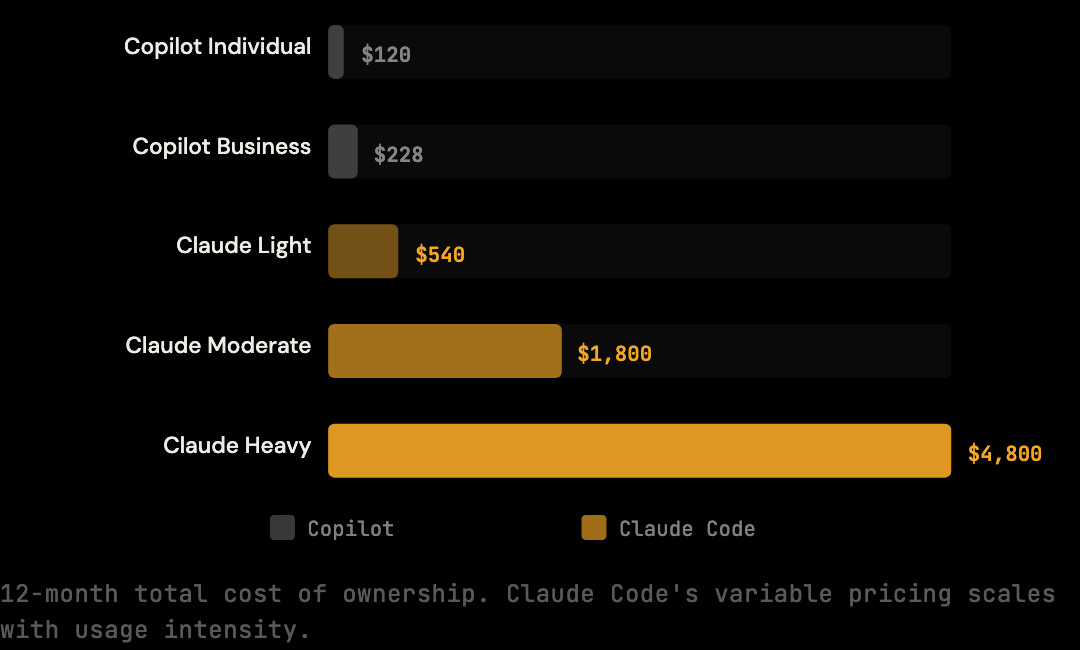
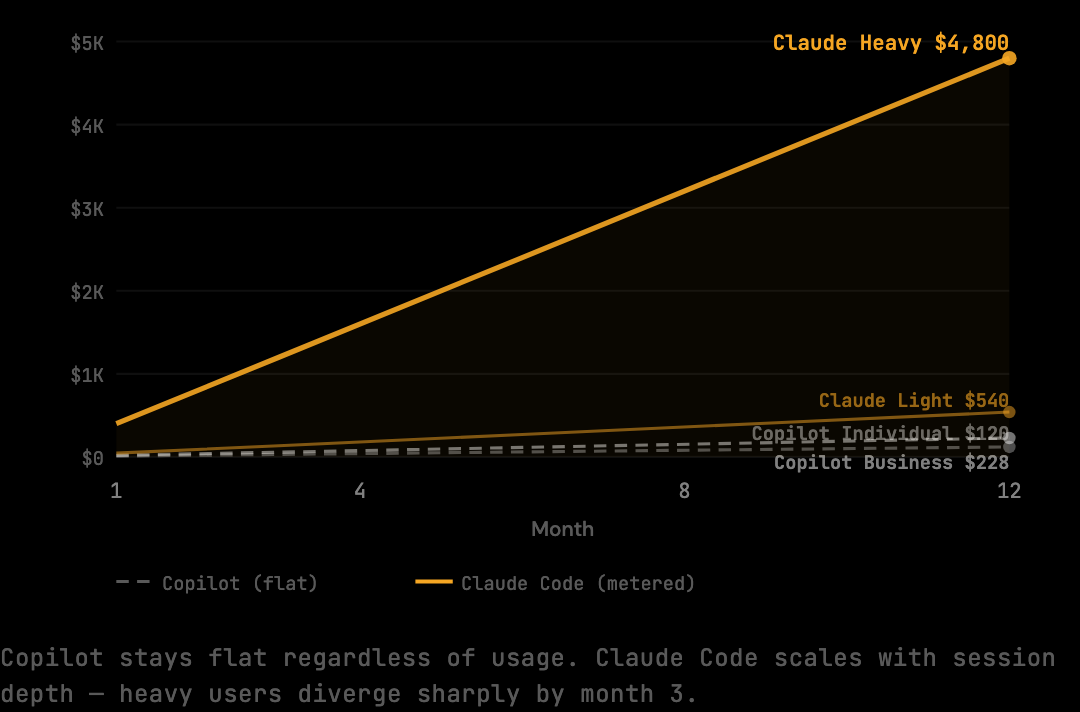
Claude Code is billed per token through the Anthropic API. A typical 30-turn coding session accumulates 1.5 million input tokens because every request resends the full conversation context. At $3 per million, that is $4.50 per session before output tokens. Annualized to two sessions per day across 240 working days, light usage runs $540/year, moderate $1,800/year, and heavy $4,800/year. For a full explanation of the compounding mechanic, see [/claude-code-api pricing/](/claude-code-api pricing/).
TCO at different usage levels:
| Usage level | Monthly estimate | 12-month total |
|---|---|---|
| Light | ~$45/mo | ~$540 |
| Moderate | ~$150/mo | ~$1,800 |
| Heavy | ~$400/mo | ~$4,800 |
Estimates based on 30-turn sessions, 50k avg input tokens at $3/M Claude Sonnet pricing. Heavy users self report $300-500+/mo across developer communities.
Against Copilot's $120-228/year, even the light Claude Code estimate ($540/year) costs more. At moderate or heavy usage, the difference is substantial.
Why Copilot and Claude Code Are Not the Same Tool
This is the most important section of this post. Copilot is a Visual Studio Code extension that provides inline completion and chat. Claude Code is a terminal based autonomous agent that reads files across the codebase, runs shell commands, modifies multiple files in a single session, and operates with degrees of autonomy that IDE chat does not. The cost difference reflects this capability gap.
GitHub Copilot is IDE integrated. It provides inline code completion, inline chat, and pull request summaries. It reads your current file and recent context to suggest completions as you type. It is designed to stay within the IDE and assist with the task in front of you.
Claude Code is agentic. It reads files across your codebase, runs shell commands, executes scripts, modifies multiple files, and operates with a degree of autonomy that IDE chat tools do not have. A Claude Code session can span 30-60 turns of back and forth, with Claude actively navigating your project rather than responding to single prompts.
Some developers use both. Some find that Claude Code replaces their Copilot usage entirely. Many find that Claude Code is specifically what they reach for on codebase level tasks (refactors, debugging across multiple files, building features from scratch), while IDE completion remains its own category.
The cost comparison is real, but it is a comparison of different things. If Copilot meets your needs, it is cheaper and that is a straightforward conclusion. If you are using Claude Code because you need agentic capability, the cost comparison to Copilot is not the right frame. You are not replacing one with the other.
The 12-month TCO Comparison
| Scenario | Tool | 12-month cost |
|---|---|---|
| Casual coding assistant | GitHub Copilot Individual | $120 |
| Team coding assistant | GitHub Copilot Business | $228/seat |
| Light agentic use | Claude Code | ~$540 |
| Moderate agentic use | Claude Code | ~$1,800 |
| Heavy agentic use | Claude Code | ~$4,800 |
The honest framing: if you use AI primarily for completion and chat, Copilot is cheaper over any time horizon. If you use Claude Code for agentic work, you are paying for a different capability, and the cost is proportional to how much you use it.
What Changes the Math
Two factors shift the Claude Code numbers. Session depth controls how much context accumulates per session, which compounds the per request cost. Token optimization at the proxy layer reduces per request volume, which compounds the savings across an entire session.
Session depth. Longer agentic sessions cost more than shorter ones. A focused 20-turn session generating 30k avg input tokens costs $1.80. A 50-turn session with large file reads and shell output averaging 80k input tokens costs $12.00. The power user TCO is driven by session depth more than session frequency.
Token optimization. The compounding context window means that reducing input tokens per request has a multiplied effect. Real world reduction is 30-60% depending on session patterns. The 40% standard benchmark applied to $4,800/year reduces it to $2,880/year, a $1,920 saving; the 30-60% real world range converts $4,800/year to roughly $1,920-$3,360/year. Tools like The Distillery implement this reduction at the proxy layer with a single environment variable change. The difference more than covers any optimization tooling.
Hidden Costs the TCO Table Does Not Capture
The dollar figures above cover API charges and subscription fees, but two operational costs fall outside the table. For Claude Code at the team level, API key management adds non trivial overhead: provisioning per developer keys, rotating them on offboarding, setting up spending alerts, and reviewing the Anthropic console for anomalous usage patterns. Copilot Business centralizes this under GitHub's OAuth flow, an admin grants or revokes a seat, and the developer authenticates through their existing GitHub account. There is no key management step. For teams already on GitHub Enterprise, Copilot's provisioning model is closer to zero marginal effort per seat. Claude Code's per key model requires at minimum a policy decision about how keys are shared, stored, and revoked, which has a real but hard to-quantify operational cost.
What Each Tool Does Best
Choosing between the tools is easier when each is mapped to what it actually does well, rather than what its marketing implies. GitHub Copilot is at its strongest on inline completion and pattern driven boilerplate. Claude Code is at its strongest on tasks that require crossing file boundaries with autonomous decision making. The categories barely overlap.
Copilot's inline completion is fast, low friction, and continuously available as you type. It saves keystrokes on every line. The chat panel handles bounded questions about the current file or open buffer. For the work that fits inside an IDE, this is the optimization that compounds the most across a workday. Claude Code does not provide an equivalent inline experience.
Claude Code's autonomous navigation is the inverse: it is high friction per session (you describe the task, it executes for minutes) but it handles work that requires reading multiple files, running commands, and synthesizing results. Refactors that span subsystems, debugging that requires running tests and reading their output, multi file feature builds, and migrations all sit in this category. Copilot's chat does not handle these well because it lacks the tool access and the long horizon execution model.
The practical pattern: developers use both. Copilot for the inline work of typing code, Claude Code for the high cognition work of architectural decisions. The combined bill is Copilot's flat $10-19/month plus a smaller Claude Code metered cost, because only the agentic work routes through the API.
When the Free Copilot Tier Changes the Math
GitHub Copilot has a free tier with limits (2,000 completions/month, 50 chat messages/month). For developers whose work fits inside those limits, Copilot is genuinely free. The break even comparison shifts dramatically at zero versus $540/year for Claude Code's lightest usage.
The free tier does not include agent mode and does not match paid Copilot's capability for unlimited completion. For developers doing primarily inline work below the 2,000-completion threshold, it is a complete tool at no cost. For anyone hitting those limits, the choice returns to paid Copilot ($120-228/year) versus Claude Code's metered model.
The free tier does not replace Claude Code's agentic mode for any user. The capability difference is not about quota. Even unlimited Copilot does not provide autonomous multi file workflows. The free tier is relevant to the inline completion comparison, not the agentic comparison.
The Honest Verdict
If GitHub Copilot meets your needs, it is cheaper. No ambiguity. The $120/year vs $540+/year comparison is not a close call for most usage patterns.
If you are on Claude Code because you need agentic capability, reading and editing across your codebase, running commands, building complex features autonomously, the cost is the cost. It scales with how deeply you use it. That is the right tool for some workflows, and it is worth paying for those workflows.
Frequently Asked Questions
Q: Can I use Copilot's free tier and Claude Code together to lower my total bill?
Yes. Copilot's free tier handles inline completion at no cost up to 2,000 completions per month. Claude Code handles the agentic work that Copilot's chat does not match. The combined monthly bill is whatever Claude Code metering produces, with no Copilot charge below the free tier limits. For light agentic users this is the cheapest combination.
Q: How does Copilot Business pricing scale for a team?
Copilot Business is $19/month per seat, $228/year per seat. A 10-developer team pays $2,280/year flat. The same team running Claude Code at moderate usage hits $18,000/year ($1,800 per developer × 10). The flat subscription advantage compounds with team size on Copilot.
Q: Does Claude Code work as a Copilot replacement?
Not for inline completion. Claude Code is terminal based and does not provide IDE completion as you type. It can be used for the bounded refactors and chat driven edits that Copilot's chat handles, but the per session metering makes this expensive for high frequency small tasks. For inline work, Copilot remains the better fit.
Q: Is the 12-month TCO calculation realistic for solo developers?
Yes for the brackets defined. Light Claude Code usage (1 session/day, 30 turns) is roughly $45/month and $540/year. Heavy users posting in developer forums consistently report $300-500/month bills, putting them at $3,600-$6,000/year. The $4,800 heavy figure is a midpoint of those reports, not an outlier.
Q: Will switching from Copilot to Claude Code save money for any usage pattern?
No. Copilot is structurally cheaper because it has no per token component. The only scenario where Claude Code matches or beats Copilot's $120/year is occasional usage below ~30 sessions per year, where metering produces less than $120 in API charges. For consistent daily use, Copilot is always cheaper in absolute terms; the question is whether its capabilities cover the work.
If you are committed to Claude Code, The Distillery is how you make the economics work. It distils repeated context before each request reaches Anthropic, producing 30-60% cost reduction depending on session patterns, highest on the heavy agentic sessions that drive most of the cost.
Try it on your own Claude Code sessions.
The Distillery applies these distillations automatically. Free token optimization, forever.