Claude Code Cost Optimization Guide: 30-60% Cost Reduction, Measured
Claude Code costs drop 30-60% with context distillation — 40% measured on a reproducible standard-session benchmark. The methodology, the math, and the one-minute test.
30-60% cost reduction on real Claude Code sessions, depending on session patterns — with a measured 40% reduction on a reproducible standard-session benchmark, and up to 85% on heavier sessions.
That is the result of running scripts/benchmark.ts in The Distillery repository against a corpus of multi-turn coding conversations. Not an estimate. Not a best-case scenario. A deterministic benchmark you can run yourself and verify in under a minute.
This post covers the methodology behind that number, what optimizations produce it, and how to apply them to your own Claude Code sessions.
TL;DR
- The benchmark runs a fixed corpus of realistic Claude Code session fixtures through the optimization pipeline and reports raw versus optimized token counts.
- The reproducible reduction at the smart preset is 40% on the standard-session corpus (heavier sessions reduce up to 85%). Real-world sessions with heavy shell output or repeated file reads see 30-60% depending on session patterns.
- Five distillers handle the reduction: shell output distillation, duplicate content deduplication, tool result trimming, smart array sampling, and code distillation.
- Setup takes two commands:
npm install -g thedistilleryandthedistillery start— Claude Code is auto-configured. - The 40% standard-session figure is representative, not a ceiling — heavier sessions reduce more. Per-session stats reveal the actual delta on your specific workflow.
The Benchmark
The benchmark lives at scripts/benchmark.ts in The Distillery repository. It runs the optimization pipeline against a fixed corpus of 5 multi-turn Claude Code session fixtures (37,052 raw tokens) and reports the reduction. The figure is deterministic: same corpus and same preset always produce the same result. It is designed to be representative and reproducible, not a best-case scenario.
What it measures: The script runs applyOptimizations() against a corpus of realistic Claude Code fixtures from scripts/benchmark-fixtures.ts. These fixtures represent actual coding session patterns: multi-turn conversations with tool calls, file reads, shell output, and accumulated context.
How tokens are counted: The benchmark uses the chars/4 convention, the same estimation method used internally by the optimization pipeline. This keeps the measurement consistent and auditable.
Model and preset: claude-sonnet-4-5, smart preset. The smart preset applies the core optimizations without deep distillation that might risk semantic loss.
Running it:
npx tsx scripts/benchmark.tsExample output:
{
  "reductionPercent": 40,
  "rawTokens": 37052,
  "optimizedTokens": 22080,
  "model": "claude-sonnet-4-5",
  "preset": "smart",
  "fixtures": 5,
  "script": "scripts/benchmark.ts",
  "corpus": "scripts/benchmark-fixtures.ts"
}
The reductionPercent of 40 is the key number. rawTokens is what Claude Code would send without optimization. optimizedTokens is what actually gets forwarded to Anthropic after the pipeline runs. The difference is real tokens that do not get billed.
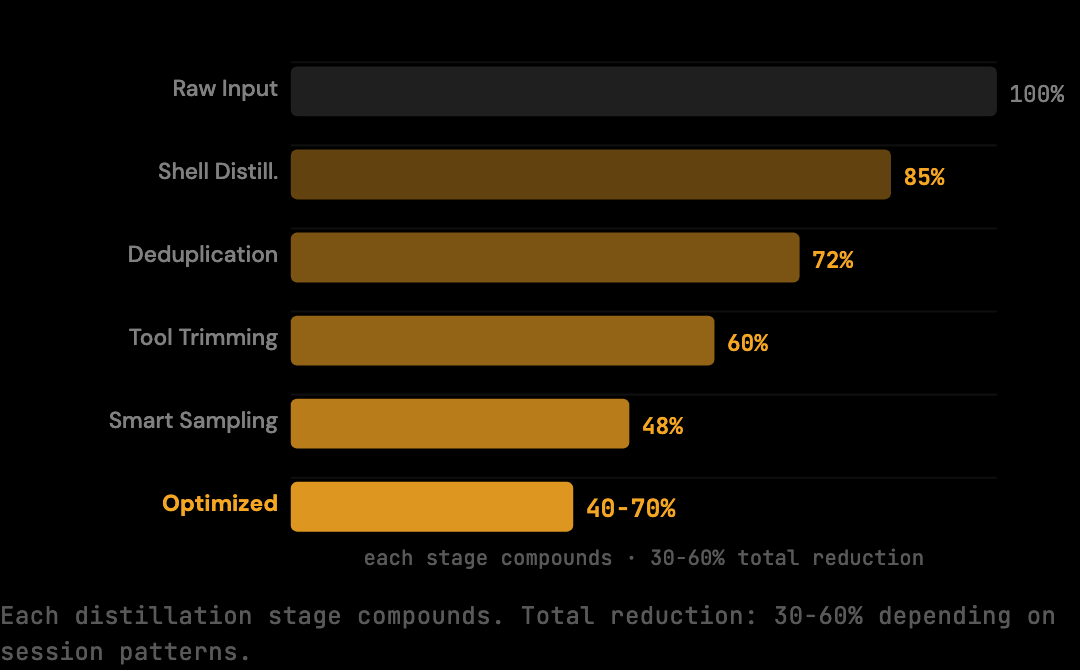
What Gets Optimized
The reduction (40% measured on the standard-session benchmark, up to 85% on heavier sessions; 30-60% in real-world use depending on session patterns) comes from applying targeted optimizations to each request before it reaches Anthropic. Three primary stages run on every request: shell output distillation (often 40-60% reduction on terminal output), duplicate content deduplication (file reads that appear multiple times), and tool result trimming (verbose stack traces and listings). Each stage targets a specific source of redundancy.
Shell Output Distillation
Build logs, test results, and terminal output are the largest source of redundant tokens in most coding sessions. The distiller identifies repetitive patterns (timestamps, progress bars, ANSI escape sequences, repeated file paths) and removes them while preserving the information that matters: error messages, final results, and failure context.
Before:
  PASS src/auth/login.test.ts (2.3s)
  PASS src/api/routes.test.ts (1.8s)
  PASS src/db/queries.test.ts (3.1s)
  ... (41 more passing suites)

  Test Suites: 44 passed, 44 total
  Tests:       312 passed, 312 total
  Time:        28.4s
After:
[44 test suites: 312 passed, 0 failed — 28.4s]
Same information. Roughly 85% fewer characters in the test output block.
Duplicate Content Deduplication
When the same file is read multiple times across a session (which happens frequently when Claude iterates on a fix), subsequent appearances in the context are shortened to reference the first occurrence. The model still has access to the content; it is just not re-transmitted in full every time.
Tool Result Trimming
Full stack traces, complete directory listings, and verbose JSON responses contain more information than the current task typically requires. The trimmer applies contextual truncation: preserving the first and last portions of long outputs (where errors and summaries usually live), with a count of omitted content.
Before (abbreviated):
Error: ENOENT: no such file or directory, open '/project/config/database.json'
    at Object.openSync (node:fs:596:3)
    at Object.readFileSync (node:fs:464:35)
    at loadConfig (/project/src/config.ts:12:18)
    at createApp (/project/src/app.ts:8:22)
    at Object.<anonymous> (/project/src/index.ts:4:1)
    at Module._compile (node:internal/modules/cjs/loader:1364:14)
    at Module._extensions..js (node:internal/modules/cjs/loader:1422:10)
    ... (18 more stack frames)
After:
Error: ENOENT: no such file or directory, open '/project/config/database.json'
    at loadConfig (/project/src/config.ts:12:18)
    [18 frames omitted]
The error and the relevant call site are preserved. The Node.js internals are not.
How to Set It Up
The optimization runs as a local proxy. Your API key stays on your machine. Your workflow does not change. thedistillery start auto-configures Claude Code — nothing else required.
Step 1: Install
npm install -g thedistilleryStep 2: Start the proxy
thedistillery startStep 3: Use Claude Code as normal
No changes to your prompts. No configuration file required. Every API request from Claude Code now routes through the local proxy, which applies optimizations and forwards the reduced context to Anthropic.
Step 5: Check your savings
thedistillery statsThis shows per-session token counts, raw versus optimized, so you can see the reduction in your actual usage patterns, not just the benchmark corpus.
Beyond the Standard-Session Benchmark
The 40% figure is the measured standard-session reduction on the fixed fixture corpus at the smart preset. It is designed to be representative and reproducible.
Real-world sessions see 30-60% cost reduction depending on session patterns. The variation comes from what your sessions contain. Sessions with heavy shell output (long build logs, test runs, linter output) give the distiller more to work with. Sessions with repeated file reads give deduplication more opportunities. The longer a session runs, the more accumulated context accumulates, and the more the pipeline can remove.
The benchmark gives you a representative baseline. Your actual sessions tell you the ceiling.
Methodology Notes
The benchmark is designed to be falsifiable rather than impressive. The corpus, the optimization pipeline, and the token estimation method are all in the public repository. If your sessions reduce by less than the benchmark's 40%, the comparison is meaningful: it suggests your sessions contain less redundancy than the benchmark fixtures, which is useful information for tuning the preset or understanding your workflow.
Specifically: the corpus lives at scripts/benchmark-fixtures.ts (a set of realistic multi-turn conversations representing typical Claude Code usage patterns); the optimization pipeline at src/optimization/index.ts is applied deterministically; token estimation is chars/4, applied the same way to both raw and optimized messages.
Common Mistakes That Reduce the Reduction
Three configuration mistakes commonly reduce the achievable savings without obvious symptoms. Each is worth checking when the per-session reduction is lower than the benchmark suggests.
The first is leaving DISTILLERY_BYPASS=1 set from a previous debugging session. Bypass mode tells the proxy to forward requests unchanged. Sessions run normally, the proxy accepts traffic, but no distillation happens. The bill is the same as running without the proxy at all. Check with echo $DISTILLERY_BYPASS. If it prints a value, unset it.
The second is the proxy not being configured for Claude Code. thedistillery start writes ANTHROPIC_BASE_URL=http://localhost:3080 into ~/.claude/settings.json — if that entry is missing, Claude Code talks to Anthropic directly. To verify, run cat ~/.claude/settings.json and look for ANTHROPIC_BASE_URL. (For non-Claude-Code tools set the env var manually; echo $ANTHROPIC_BASE_URL should return http://localhost:3080.)
The third is running with the wrong preset. The default smart preset is tuned for the 40% standard-session benchmark. The aggressive preset removes more content but may affect Claude's ability to handle very specific edge cases. The safe preset is more conservative. Mismatched preset for the workload reduces the achievable saving without breaking anything.
What the Benchmark Does Not Cover
The benchmark measures input token reduction on a fixed corpus. It does not measure several things that matter in production. It does not benchmark Claude's response quality (the assumption is that removing redundant content does not affect output, which holds because the distillers preserve semantic content). It does not measure latency overhead from the proxy (typically 10-30 ms per request, negligible against Anthropic's response times). It does not benchmark output token reduction (the proxy does not modify output).
For the parts the benchmark does not cover, the verification path is empirical. Run the proxy on real sessions, observe whether output quality changes (it should not), and measure the actual per-session reduction with thedistillery stats. The benchmark is a representative baseline for input reduction; the per-session stats are the truth for any specific workflow.
What to Do After Running /compact
The /compact command in Claude Code summarizes the conversation into a condensed system message and clears prior turns. It is useful for resetting a long session, but it is not a substitute for reviewing the context afterward. After running /compact, open the session stats with thedistillery stats --session latest and check whether the optimized token count dropped proportionally. If it did not, the session had already been efficiently compacted by the pipeline and manual /compact added limited benefit. If it dropped significantly (by 30% or more), the session was carrying redundant content that the proxy had been preserving because it appeared non-duplicate — a signal that future sessions on the same task would benefit from an earlier /compact call.
The Compounding Effect
The savings from a single session are modest in absolute terms. A 40% reduction on a $4.50 session saves $1.80. The number that matters is cumulative: over 20 sessions per week, that is $36/week, or roughly $144/month for a developer using Claude Code daily.
The benchmark is reproducible. The setup takes two minutes. The reduction compounds with every session.
Frequently Asked Questions
Q: Why does the standard benchmark measure 40%?
The benchmark corpus is a representative sample of standard Claude Code sessions, not a worst-case scenario. Real sessions vary: tightly scoped sessions with little redundancy reduce by less, heavy agentic sessions with repeated tool calls reduce by 53-85%. The 40% figure is a representative standard-session measurement, reproducible across users, with real-world savings of 30-60% depending on session patterns.
Q: Does the benchmark use real Claude API calls?
No. The benchmark uses fixed fixtures stored in scripts/benchmark-fixtures.ts and runs them through the optimization pipeline locally. No API keys are required. No tokens are billed. The benchmark is a measurement of the pipeline's behavior, not a test of Anthropic's API.
Q: How long does the benchmark take to run?
Under a minute on a modern laptop. The pipeline runs deterministically on 5 fixtures totaling 37,052 raw tokens. There is no network I/O. The result is reported as a JSON object that the user can parse or copy directly.
Q: Will the optimization affect Claude's output quality?
No, by design. The distillers remove redundant transmission (duplicate file reads, verbose shell output formatting, stale tool results) without removing semantic content. Claude's understanding of the context is preserved because the relevant signal is preserved. The benchmark does not directly test this, but the pipeline's design and source code reflect the constraint.
Q: Can I run the benchmark on my own session data?
Yes, by adding fixtures to scripts/benchmark-fixtures.ts. The fixtures are TypeScript files that export message arrays, and the benchmark runs against whatever is exported. Adding your own session captures lets you measure the pipeline's reduction on your specific workflow patterns rather than the default corpus.
If you want to understand exactly why Claude Code sessions accumulate so many tokens in the first place, the cost mechanics post covers the underlying model.
Ready to start? Install The Distillery and run the benchmark yourself.
Try it on your own Claude Code sessions.
The Distillery applies these distillations automatically. Free token optimization, forever.