Cursor vs Claude Code (2026): real cost breakdown
Cursor Pro: $20/mo flat. Claude Code at 4+ sessions/day: $300-500/mo. Break-even is 1-2 sessions/day, here is when each is actually cheaper.
Cursor costs $20/month. Claude Code via API has no ceiling.
Whether that matters depends entirely on how you use it. For many developers, Cursor Pro is the rational choice, a flat subscription, no surprises, Claude Sonnet included. For others, the API billing of Claude Code is worth it. The question is which side of that line you fall on.
TL;DR
- Cursor Pro is $20/month flat with Claude Sonnet bundled. Claude Code is metered at $3/M input and $15/M output with no ceiling.
- Light users (1-3 short sessions/day) almost always pay less on Cursor. Heavy agentic users (4+ deep sessions/day) routinely run $300-500/month on Claude Code.
- The break even point sits around 1-2 sessions per day. Above that, Claude Code costs more than Cursor in absolute terms.
- The two products are not interchangeable. Claude Code has agentic capabilities (multi file edits, shell access, autonomous navigation) that Cursor's chat does not match.
- For developers committed to Claude Code, 30-60% reduction (depending on session patterns) via context optimization converts $400/month into $160-$280/month on typical sessions.
What Cursor Pro Actually Includes
Cursor Pro is $20 per month flat with Claude Sonnet access included. There is no token meter, no usage cap, and no per session billing. The fixed subscription removes the variable cost dimension entirely, which is the single biggest difference from Claude Code's per token pricing model.
The bundle includes code completion, multi file editing, and agent mode. Cursor uses Claude models under the hood, so the model your Claude Code workflow runs on is available inside Cursor, just bundled into a flat subscription rather than metered per token.
For developers who use AI coding tools regularly but not in long agentic runs, this is a straightforward win. You know what you are paying.
What Claude Code Actually Costs
Claude Code is billed through the Anthropic API at $3/M input and $15/M output (Sonnet, 2026 pricing). A typical 30-turn coding session accumulates 1.5 million input tokens because every request resends the full conversation context. That puts the floor of a single session around $4.50 in input alone, before output tokens. There is no monthly cap.
Claude Code bills through the Anthropic API. As of April 2026:
- Input tokens: $3.00 per million
- Output tokens: $15.00 per million
The math on a typical session:
30 turns × 50,000 avg input tokens = 1,500,000 input tokens
1,500,000 × $3.00 / 1,000,000 = $4.50 per session
That is a single session. Two sessions per day, across 20 working days, before accounting for output tokens: $180/month from input tokens alone. Add output tokens and the occasional deep session, and $200-300/month is not unusual for a developer who uses Claude Code as their primary tool.
The key difference from Cursor: there is no ceiling. A complicated refactor that runs 60 turns costs more than a 20-turn session. A day with three sessions costs more than a day with one. The bill is a function of usage, not a flat commitment.
The compounding mechanic is what makes Claude Code billing hard to predict from session count alone. Unlike a per message pricing model, every turn in a session resends the full accumulated history. Turn 1 sends 2,000 tokens. Turn 2 sends 4,000 tokens (turn 1 plus the new exchange). Turn 30 might send 50,000 tokens even if the most recent exchange was only 500 tokens of new content. The total billed tokens for a 30-turn session is not 30 times the average turn length, it is the sum of a growing series. A session where each turn adds 1,000 net tokens accumulates roughly 465,000 input tokens total by turn 30, not 30,000. This is why two developers who "use Claude Code the same amount" can report wildly different monthly bills depending on whether they restart sessions frequently or let them run long.
When Cursor Is Cheaper
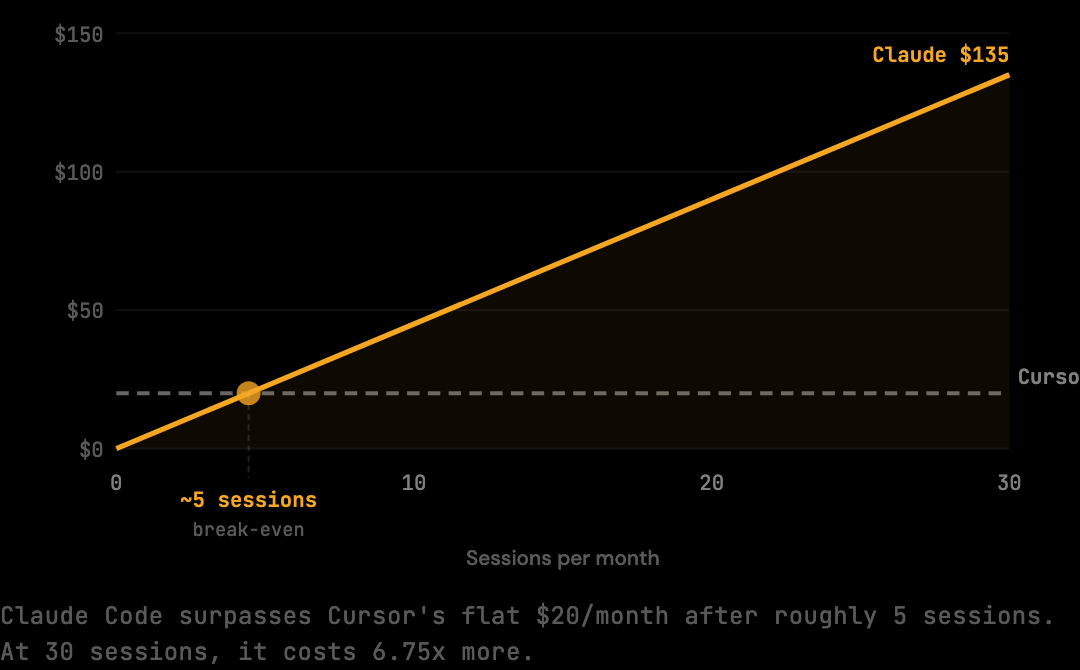
For one to three short sessions per day with focused tasks wrapping up in 20-30 turns, Cursor's $20 flat fee almost always undercuts Claude Code's metered cost. A single 30-turn Claude Code session bills around $4.50. After roughly five sessions in a month, Claude Code surpasses Cursor's price. Realistic light usage clears that threshold within the first week.
The flat subscription is also a form of budget predictability. You can give a developer a Cursor Pro seat and know the per seat cost, indefinitely. With Claude Code on the API, the cost depends on how that developer works: how deep their sessions go, how often they restart context, how many parallel workstreams they run.
If you use AI coding tools occasionally, or if you primarily use AI for completion and inline suggestions rather than long agentic runs, Cursor wins on pure cost with no calculation needed.
When Claude Code Gets Expensive
Power users hit a different curve. Three or more sessions per day, each running 40 or more turns with file reads and shell output included in context, routinely produces $300-500/month bills. The same usage on Cursor Pro stays at $20. Whether the gap is justified depends entirely on whether the agentic capabilities matter for the work being done.
The compounding context window is the mechanism behind this. Each turn re-sends everything. A session that accumulates 100,000 input tokens per turn costs $0.30 per turn. At 40 turns, that session alone is $12. Two of those sessions per day across 20 working days: $480/month from one developer.
This is not an edge case for committed Claude Code users. It is the median experience reported in developer communities.
The Comparison in Numbers
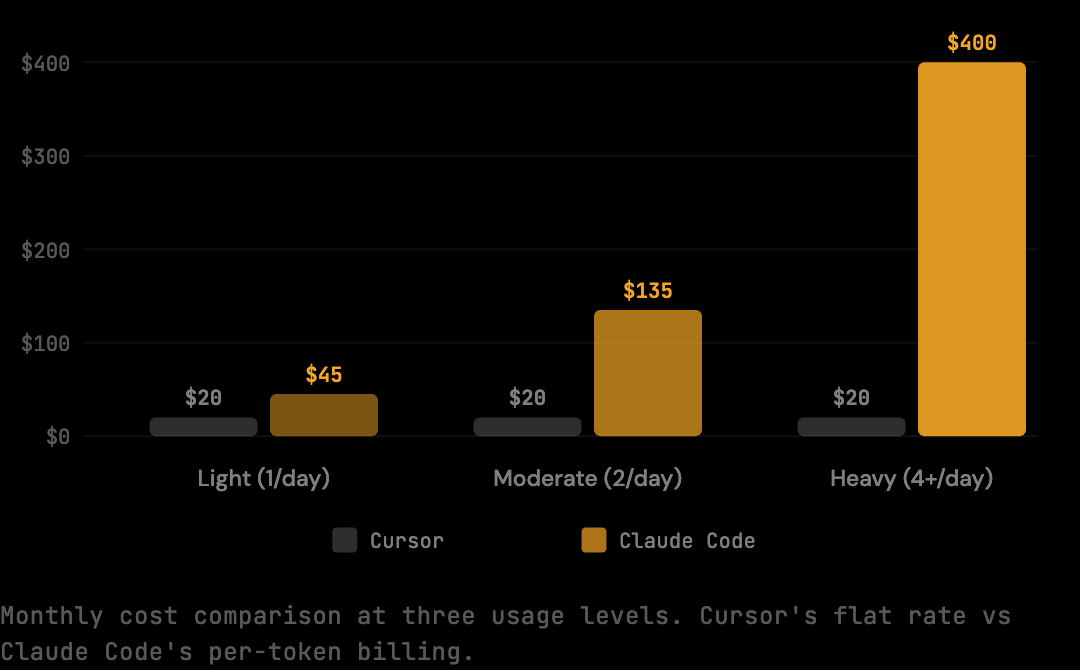
| Usage pattern | Cursor Pro | Claude Code (est.) |
|---|---|---|
| Light (1 session/day) | $20/mo | ~$45/mo |
| Moderate (2 sessions/day) | $20/mo | ~$90–180/mo |
| Heavy (4+ sessions/day) | $20/mo | $300–500+/mo |
Claude Code estimates based on 30-turn sessions, 50k avg input tokens at $3/M. Actual costs vary with session depth and model. Heavy usage represents sessions that run 40+ turns with file reads and shell output included in context.
Why the Two Products Are Not Equivalent
Cursor and Claude Code occupy adjacent but distinct categories. Cursor is an IDE with embedded chat and agent mode, optimized for inline completion and bounded refactors within a single editor session. Claude Code is a terminal based agent that operates across the codebase autonomously, runs shell commands, and handles multi file workflows. The cost comparison is real, but it is comparing different tools against different jobs.
For developers whose AI coding work is primarily inline completion, single file refactors, and chat driven edits, Cursor is functionally complete at $20/month. There is no agentic capability they are leaving on the table. The cost question reduces to "what does Cursor Pro cost compared to nothing," and Cursor Pro is the answer.
For developers running long horizon tasks (large refactors, multi package migrations, debugging that spans subsystems), Claude Code's autonomous navigation and shell access are not features Cursor offers in the same form. The cost is a function of how much agentic work is being delegated, and the choice is whether that work is worth the metered price. The two products are not substitutes for each other in this category.
What Cuts a Heavy Claude Code Bill
Two levers reduce a Claude Code bill without switching tools: shortening sessions and reducing input volume per request. Shorter sessions cap the compounding cost of context retransmission. Lower per request volume cuts what is sent to Anthropic on every turn. Both can be applied simultaneously.
Session shortening is a workflow discipline: starting fresh context windows when a task pivots, scoping sessions to single subsystems, restarting when output quality starts degrading. It cuts cost at the source by limiting how much accumulates.
Per request volume reduction happens at the proxy layer. A token optimization proxy intercepts each Claude Code request, removes redundant content (duplicate file reads, verbose shell output, stale tool results), and forwards a smaller payload. Tools like The Distillery report 30-60% cost reduction depending on session patterns. At the 30-60% range, $400/month converts to roughly $160-$280/month. For developers above the Cursor threshold who are committed to Claude Code, this is the closest thing to a flat fee approximation that the metered model allows.
The Honest Verdict
For moderate users, Cursor Pro is the rational choice. A $20 flat subscription is simply cheaper than $90-180/month in API costs. That is not a close call.
For developers who specifically want Claude Code, for its agentic capabilities, terminal access, codebase level autonomy, or workflow integration, the cost is real and scales with how you use it. Cursor Pro does not give you the same tool. Some developers find the distinction matters; others find it does not.
If you are committed to Claude Code, the cost is a known variable, not a reason to switch. It is also optimizable. The compounding context window mechanic means that reducing input tokens on each request has a measurable effect on your bill. 30-60% reduction depending on session patterns converts $400/month into roughly $160-$280/month. For a heavy user, that compounds significantly over a year.
Frequently Asked Questions
Q: Can I use both Cursor and Claude Code together?
Yes, and many developers do. They use Cursor for inline completion and bounded refactors inside the IDE, and Claude Code for agentic work that spans multiple files or requires shell access. The combined cost is Cursor's $20/month plus a smaller Claude Code metered bill, because the agentic work is the only thing routed through the API.
Q: What is the break even point between the two?
Roughly four to five Claude Code sessions per month at standard 30-turn depth. Each session costs around $4.50 in input alone. Five sessions hit Cursor's $20/month price. Above that volume, Claude Code costs more in absolute terms. Below it, Claude Code can be cheaper if usage is sporadic.
Q: Does Cursor's bundled Claude access count toward Anthropic's API quotas?
No. Cursor handles the Claude API access internally as part of its subscription. Your Anthropic API quota and billing are unaffected by Cursor usage. The two are entirely separate billing relationships, which is the source of Cursor's predictable pricing.
Q: Is Cursor's agent mode equivalent to Claude Code's agentic capabilities?
Cursor's agent mode handles multi file edits within the IDE and basic codebase navigation. Claude Code is a terminal based agent with broader tool access (shell commands, arbitrary file system operations, longer autonomous runs). The two overlap on bounded refactors but diverge on long horizon tasks. Most heavy Claude Code users report Cursor's agent mode does not fully replace it.
Q: How much can context optimization save on a $400/month Claude Code bill?
At the 40% standard benchmark reduction, $400/month becomes $240/month, a $160/month saving or $1,920/year. Heavy agentic sessions with denser redundancy see 30-60% reductions, which would convert $400/month into roughly $160-$280/month. The exact figure depends on session patterns; sessions with heavy shell output and repeated file reads are at the higher end.
If you are committed to Claude Code, The Distillery is how you make the economics work. It intercepts each API request, distils repeated context, and forwards a smaller payload to Anthropic. 30-60% cost reduction depending on session patterns. Two commands to install. No changes to your workflow.
Try it on your own Claude Code sessions.
The Distillery applies these distillations automatically. Free token optimization, forever.